Chris Foss, visionary artist for the Space Generation

I’ve just bought a copy of “Hardware – the definitive SF works of Chris Foss” – an ideal read on a wet and stormy afternoon. A massive piece of work of 240 pages, it lovingly pictures the incredible visions of this remarkable artist. Often imitated but never bettered, Chris’ output of vast spaceships, alien landscapes and galactic skies marched across the covers of my favourite SF novels for a whole generation. For people of my age his work defined the entire genre of space opera. While Foss was notorious for producing covers for books he had never read, it is difficult to imagine a better pairing than Foss and E E “Doc” Smith of Lensman and Skylark fame.

In an introduction Rian Hughes writes, “If there had been no Chris Foss, there may have been no Star Wars. The triangular ship Foss created for A E Van Vogt’s Moonbeast in 1975 uncannily foreshadows the Imperial Star Destroyers, both in design and – perhaps more importantly – a sense of sheer scale, one on the order of cities rather than mere ships.”

OK, you know I like Star Wars models, and you may know I paint a little, but why did I include this appreciation in a Meccano Blog? Because with delight I came to Chris’ own words, looking back on a childhood spent in Guernsey:

“As a child I was obsessed with my model railway layout and Meccano. I was building and making things from a very early age – I built huge cranes. The machinery of the Victorian era was what I grew up with.”

Strange for a man who became best known for painting visions of the future! But very much a space-punk future, far removed from the sleek cigar-tube ships envisaged by his predecessors. One full of nuts and bolts, girders and beams.

So, there you find yet another seminal mind influenced as a child by his love for Meccano. No Meccano, perhaps no Foss space ships, maybe no Star Wars as we know it!

There is a thesis to be written one day on famous names who were first inspired by Meccano…

But for now, back to my new book…..

Image

One of Chris Foss's immense spaceships

ISBN9781848566989, Titan Books, £24.99, US$34.95.

Posted in Uncategorized | Tagged , , , , , , , , | Leave a comment

Mercury Atlas

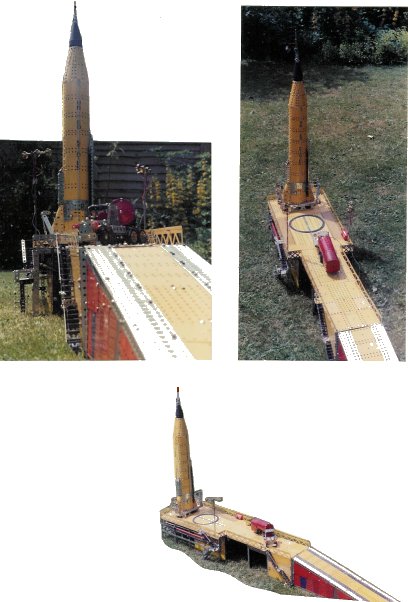
I’ve long been a fan of the American Space Program – in some senses we grew up together. Like many other youngsters I built scale models of various space craft, from fact and fiction. One of them was Revell‘s old kit of the Mercury Atlas launch complex, and that inspired me some thirty years ago (when I had less Meccano and less grey hair, too!) to build my own version in Meccano.

Mercury-Atlas

Mercury Atlas in Meccano

Now, fifty years since John Glenn was the first American Astronaut to orbit the earth I have begun to tackle this subject again: the new version is to the same scale, but it is bigger in many ways and certainly more detailed, but looking back I remain pleased with the result, a tribute to the “Magnificent Seven”, the astronauts who rode first the Redstone and then the Atlas boosters into orbit in their tiny one-man space-craft.

As to the current model – as they say, watch this space!

Posted in Space | Tagged , , , , , , , , , , , , | 1 Comment

Automotive-style handbrake

One of a series of gadgets that I have toyed with – executive toys of a sort!

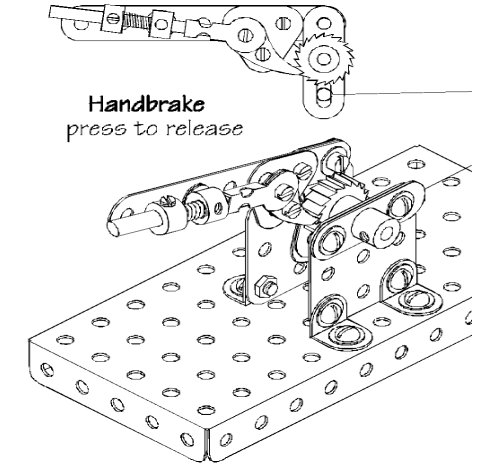
Take a 7 hole Strip and bolt a 1” x 1½” Corner Bracket to one end, and back the arm of this

Automotive-style handbrake

with a Double Arm Crank, boss rearwards. Mount a short Rod loosely in its bore, and bolt a Ratchet Wheel, boss outwards, to the other end.

To the second and third holes in the Strip, bolt a 1” Triangular Plate, using Set Screws. Lock a 3/8” Bolt with a pair of Nuts to the lower hole of this Plate, with a pair of Washers and a pair of Bossless Pawls free to move on its shank. A Rod and Strip Connector should be locknutted to the upper end of the Pawls. This Connector has a 2½” Rod fixed in it: this carries a pair of Collars and a Spring between them. The nearest Collar is held by a Bolt to the Strip but spaced from it by two Washers, but can pivot slightly. The other fixed Collar is a retainer for the Spring and is adjusted for compression.

Mount the whole unit in a framework as shown, locking the Rod to the side plates in a boss so that the Ratchet Wheel does not rotate.

A Heald or other actuating wire such as the new Bowden cables may be bolted to the bottom end of the first Double Arm Crank.

The result is a Handbrake lever of the automotive type where the lever may be pulled on, but the “thumb knob” at its head must be depressed to release it just as in a real car.

Posted in Workbench | Tagged | 1 Comment

Released from Liberty

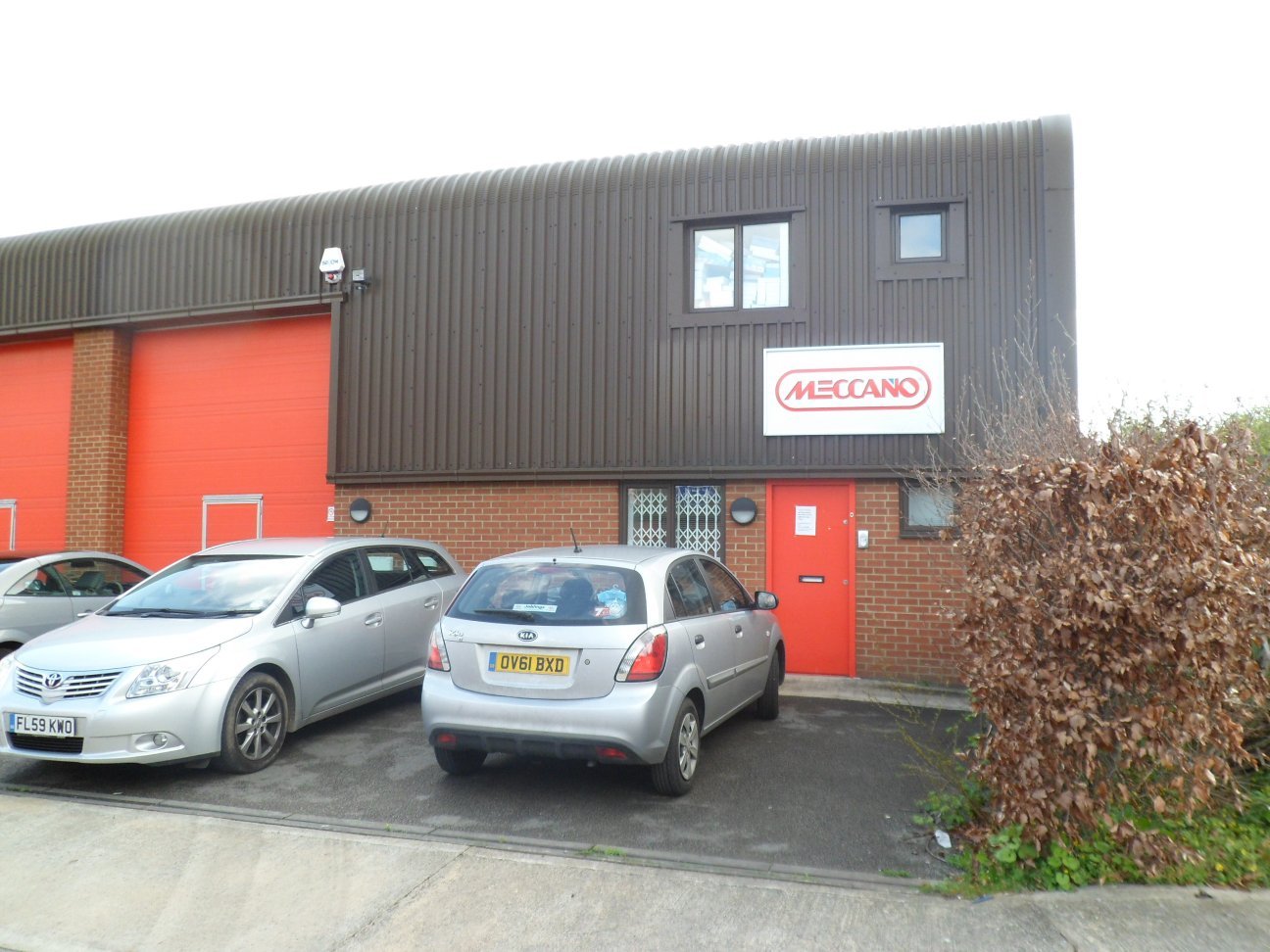
Liberty's of LondonSo, after a month in their shop window in London, my display models were safely returned by Liberty’s to Meccano UK, and Greg and I made another round trip to pick them up and bring them home. You might think of the HQ of Meccano Toys UK as being rather grand – sorry – it is actually a small office on an industrial estate, staffed by a small but very helpful and friendly team, doing a great job for the hobby. It was good to see them again – and to get a glimpse of the future – all very exciting! Thanks again to you all.

Meccano's UK Offices

Posted in Uncategorized | Tagged , | Leave a comment

The Eagle had landed ….

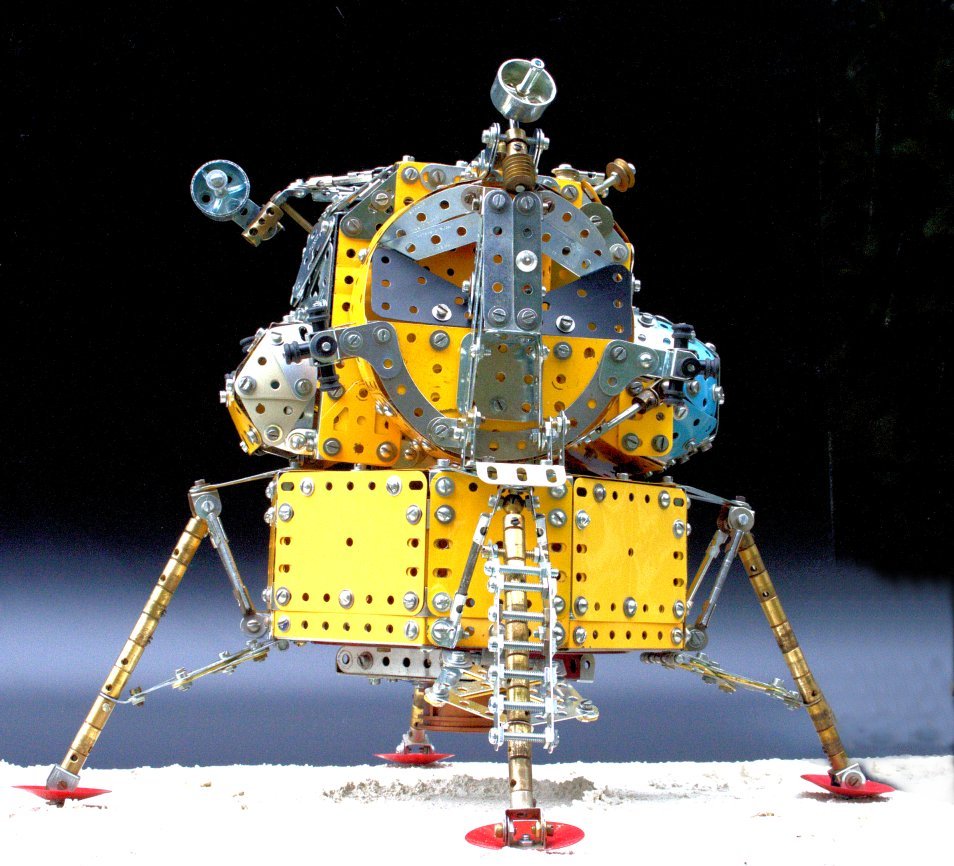
The Apollo Lunar Landing Module
Eagle LLM

In 2009 I was in nostalgic mood – probably because I was facing a significant birthday that summer!  Time to look back to days when the future seemed full of hope, any dream was possible and any problem could be solved if you could throw enough money at it. And so back to my undergraduate days (ignoring such things as student riots, segregation, Viet Nam, etc) and the biggest dream of all – a round trip to the moon!

To those of us raised on Science Fiction films and comics, be it Dan Dare, Flash Gordon, or the then new TV series, Star Trek, we all knew that space ships were sleek and smooth, shaped like disks or projectiles. But then came reality in the shape of the LLM, that little payload which was to sit shrouded at the head of the mighty Apollo Saturn V Moon-rocket.  It went through various design stages, but what emerged was unlike anything we had imagined. Angular, spidery and multi-faceted, it was a triumph of function over appearance – it did precisely what was needed – to deliver two men safely from lunar orbit to the surface and then return them to orbital rendezvous with the Command Module – and no more.

Ever since those grainy black-and-while pictures were first beamed back from the surface of the moon on July 20th 1969 it has been an iconic machine – but it has rarely been modelled in Meccano! (There is actually a 4 ft tall version in Meccano’s own official displays, though frankly it’s not the best it could be.)

There were various plastic kits around in the following years, of course, notably from Airfix, Revell and Monogram, and I was glad to have these to hand as examples. By now there is also a wealth of archive material available on the internet, so armed with these and my own reference library I decided to have a go at an anniversary model.

I toyed around with various scales, but settled eventually for one which enabled me to model the landing legs in brassware, i.e. at 3/8” diameter. I made scale drawing from there and when I found that other dimensions could be matched to standard Meccano lengths and widths of plates and strips I blew up some drawings to the size of the proposed model and began work. (Always a useful technique when you are as concerned with form as with function – being able to offer up parts to the drawings and see if they match is a great help.) The legs were made from stacked Long Bosses, though any equivalent length of brassware would do. Conveniently enough the “feet” were the size of Conical Discs, and Narrow Strips and Rods held in Rod and Strip Connectors formed the supports.

The Landing Stage was made up from Flexible Plates and 7×5 Flanged Plates joined by Obtuse Brackets, with a 6” Circular Plate forming much of the lower surface and a plastic Wheel Core representing the bottom rocket nozzle.  Plates filled in the top of the octagon, with 5×5 Triangular Plates filling in the obvious sections. I found it easiest to fix these by punching one extra central hole on the hypotenuse of each – that way it could easily be bolted to the side plates. Why did Meccano never include that hole?

The Ascent stage was much more of a challenge! Its central core was made from Flanged and Flat Plates, but the irregular and multi-faceted surfaces were more difficult.  A large variety of triangular parts were used in overlay, ranging from traditional 5×3 Flexible Plates through 1.5” Corner Brackets to several varieties of the modern dished triangular parts. Thus the side panels and the bulbous lower housings grew.

Small conical rocket nozzles were represented by Rubber Pulleys over Narrow Plastic Spacers on Long Bolts, and communication dishes were represented by Wheel Hubs from the 3-parts wheels of the late ‘70s. Modern parts such as the 1” wide Flanged Plate and a pair of Obtuse Strips were also used to mount the dish at the top front.

Bit by bit the model took shape and at last I was satisfied. I mounted it on a large piece of board which I covered with a coat of plaster in which I created “craters” and other features reminiscent of a lunar surface.

I was pleased with the result and other people have made kind comments about it –it was certainly very well received when on show at the National Space Centre! I’ve already had requests for a ModelPlan – maybe one day!

I realised in building it that without today’s range of parts I could not have built as accurate a model, so perhaps waiting 40 years was worth it. And of course, any such “homage-model” reminds one again of the brilliance of those who designed the original, and the courage and skill of those who travelled in it.

Posted in Space | Leave a comment

Sheffield in the Spring

This gallery contains 12 photos.

Well, not quite Sheffield– more like the lovely rural setting of the village hall in the exotically named Laughton-en-le_Morthen. That was the recent Spring meeting of the Sheffield MeccanoGuild, one of the great English Meccano Clubs for enthusiasts young and … Continue reading

More Galleries | Tagged , , , | 1 Comment

Taking Liberty’s

Meccanomen do get some interesting opportunities!
Image
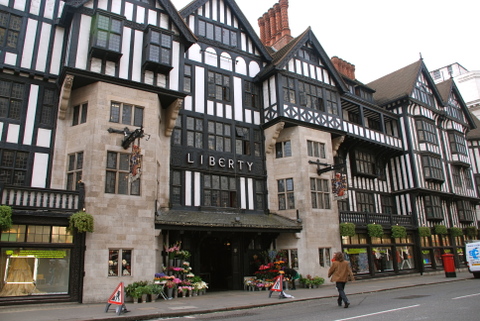
Liberty’s, the big London department store on Great Marlborough Street just off Regent Street decided to have a shop window display through March featuring Meccano! This was to help launch a kids fashion range rather than a new Meccano department.

Meccano’s UK country manager Sue Barratt said: “It was very exciting to be invited by Liberty to be involved in the launch of its new children’s department. The store is famous for creating wonderful window displays that always attract a lot of attention and this one is no exception.”

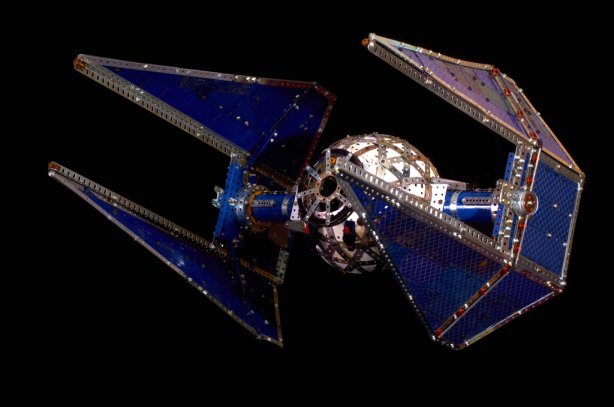
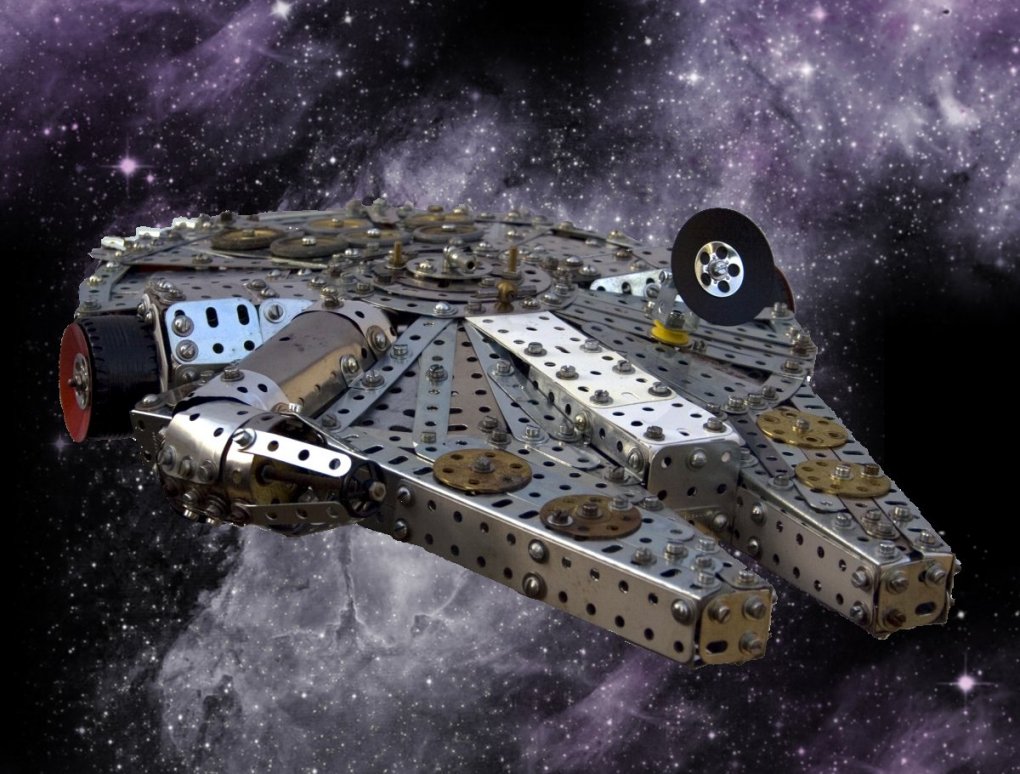
Liberty’s wanted a space theme, so they contacted Meccano via the Redbrick ad agency who contacted me again (following our last International Society of Meccanomen Show at the UK’s National Space Centre). So, my son Greg and I found ourselves getting some bits together, packing them up and driving them down to Meccano UK at Bicester – these were my models of the USA’s Lunar Landing Module and a Star Wars Millennium Falcon and the Empire’s TIE Interceptor.

Passing through London I duly called by to inspect the display and found one upside down, and one twisted round, but never mind – at least Meccano is on the High Street.

By the way, for those interested, the TIE interceptor (which I’ve not shown in public before) can be seen to best advantage at http://www.flickr.com/photos/gregwebbphotographer/sets/72157628308804805/with/6973759369/ now thanks to my son’s superb work.

Philip Webb

ISM Chair
Image

Posted in The International Society of Meccanomen, Workbench | Tagged , , , , | 1 Comment